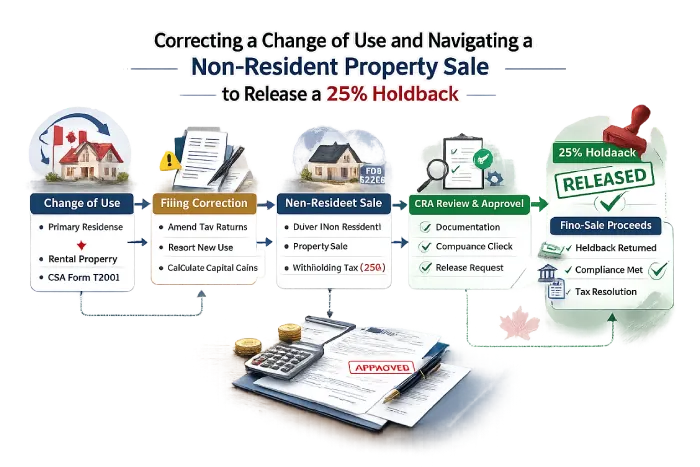
Correcting a Change of Use and Navigating a Non-Resident Property Sale to Release a 25% Holdback
March 1, 2026
SDG Team
0
Overview
A client engaged our firm after selling a Canadian residential property in connection with a move outside Canada. At closing, a significant portion of the proceeds was withheld by the purchaser’s solicitor under Canada’s non-resident disposition rules. What initially appeared to be a routine compliance matter quickly developed into a more complex file involving an unreported change in use, a deemed disposition, CRA reassessment, and the need to obtain clearance before the frozen funds could be released.
Background
The property had originally been used as a rental investment before the client later moved into it and began using it as a principal residence. However, no election or reporting was completed at the time of this conversion.
When the property was eventually sold after the client’s departure from Canada, the earlier change of use became central to the file.
Under subsection 45(1) of the Income Tax Act, converting a rental property to personal use triggers a deemed disposition at fair market value unless a valid election under subsection 45(3) is filed to defer the gain. Because no subsection 45(3) election had been made and CCA had been claimed during the rental years, CRA treated the conversion as a taxable event.
This created exposure for capital gains recognition and CCA recapture before the property was even sold.
Why Funds Were Withheld at Sale
When Canadian real estate is sold by, or potentially by, a non-resident, the purchaser is required to protect themselves from liability under section 116 of the Income Tax Act.
Without CRA clearance, the purchaser can become personally liable for the seller’s unpaid taxes.
As a result, lawyers will typically withhold up to 25% of the gross sale proceeds until CRA confirms that tax obligations have been addressed.
To obtain this clearance, the seller must file forms T2062 and T2062A, reporting the disposition and estimating the resulting tax liability. CRA then reviews the submission and issues a certificate of compliance once satisfied. In this case, the existence of an unreported change of use complicated the clearance process and delayed the release of the withheld funds.
Addressing the Change of Use
The first step was reconstructing the change-of-use event and supporting a defensible tax position.
We coordinated a retrospective valuation from a licensed real estate professional to determine fair market value at the time the property transitioned from rental use to principal residence. This valuation formed the basis for calculating the deemed disposition under subsection 45(1).
Supporting documentation outlining the property’s history, prior rental activity, and CCA claims was submitted to CRA. CRA reviewed the file, calculated the capital gain attributable to the rental period, assessed CCA recapture, and issued a tax assessment.
The resulting liability was paid directly from the funds being held in trust as part of the section 116 withholding process.
Clearance and Release of the Holdback
Once the deemed disposition had been addressed and CRA confirmed the tax obligations were satisfied, the clearance process progressed. The necessary compliance documentation was issued, allowing the legal holdback to be released.
What had begun as a stalled transaction with frozen proceeds was resolved through structured tax intervention, valuation support, and coordination with legal counsel.
Final Compliance
To ensure full alignment with CRA’s position, we prepared and filed an adjustment to the client’s personal tax return for the year in which the change of use occurred. The adjustment reflected the deemed disposition, capital gain recognition, and CCA recapture assessed by CRA.
With this completed, the client’s reporting position now fully matches CRA’s records, and the file has been brought to a compliant close.
Why This Case Matters
This case illustrates how easily a rental-to-residence conversion can create downstream tax issues when not addressed at the time it occurs. The subsection 45(3) election is often overlooked, yet it is a critical planning tool for deferring tax when changing a property’s use.
It also demonstrates the importance of understanding the section 116 clearance process. T2062 and T2062A filings, proper valuation support, and CRA coordination are essential to releasing withheld proceeds and completing a non-resident real estate transaction.
Through a combination of technical tax execution and coordinated legal strategy, we moved the client from an unresolved change-of-use issue and frozen funds to full compliance, released proceeds, and a finalized reporting position.
The information is not intended to constitute professional advice and may not be appropriate for a specific individual or fact situation. It is written by the author solely in their personal capacity and cannot be attributed to the accounting firm with which they are affiliated. It is not intended to constitute professional advice, and neither the author nor the firm with which the author is associated shall accept any liability in respect of any reliance on the information contained herein. Readers should always consult with their professional advisors in respect of their particular situations.