Definition of a Fractional CFO

When businesses grow and financial complexity rises, simple bookkeeping and accounting are probably no longer enough. With increasing revenue, a larger number of employees, erratic cash flow, and bigger financial decisions, management becomes more difficult. Yet it might not be necessary to employ a full-time Chief Financial Officer at this stage. A fractional CFO is then a reasonable alternative.

By hiring a fractional CFO, businesses can obtain experienced financial guidance on a part-time or flexible basis, thus avoiding the necessity of employing someone on a full-time basis. This setup enables companies to access the strategic expertise they need and allows the level of support to increase as the business grows.

At SDG Accountant, we help businesses access experienced financial expertise through professional Fractional CFO services designed to provide the insights and support of a Chief Financial Officer without the commitment of hiring a full-time executive.

The responsibilities of a fractional CFO and the way this position differs from those of an accountant, a controller, or a full-time CFO are set out below.

Important: Learn how a Fractional CFO provides strategic financial leadership, improves cash flow, supports business growth, and delivers CFO expertise without the cost of a full-time executive.

What Constitutes a Fractional CFO?

A fractional CFO is a financial executive with considerable experience who provides his services to businesses on a part-time basis. Instead of working full-time for a single company, he offers a customized degree of financial guidance to a number of different organizations.

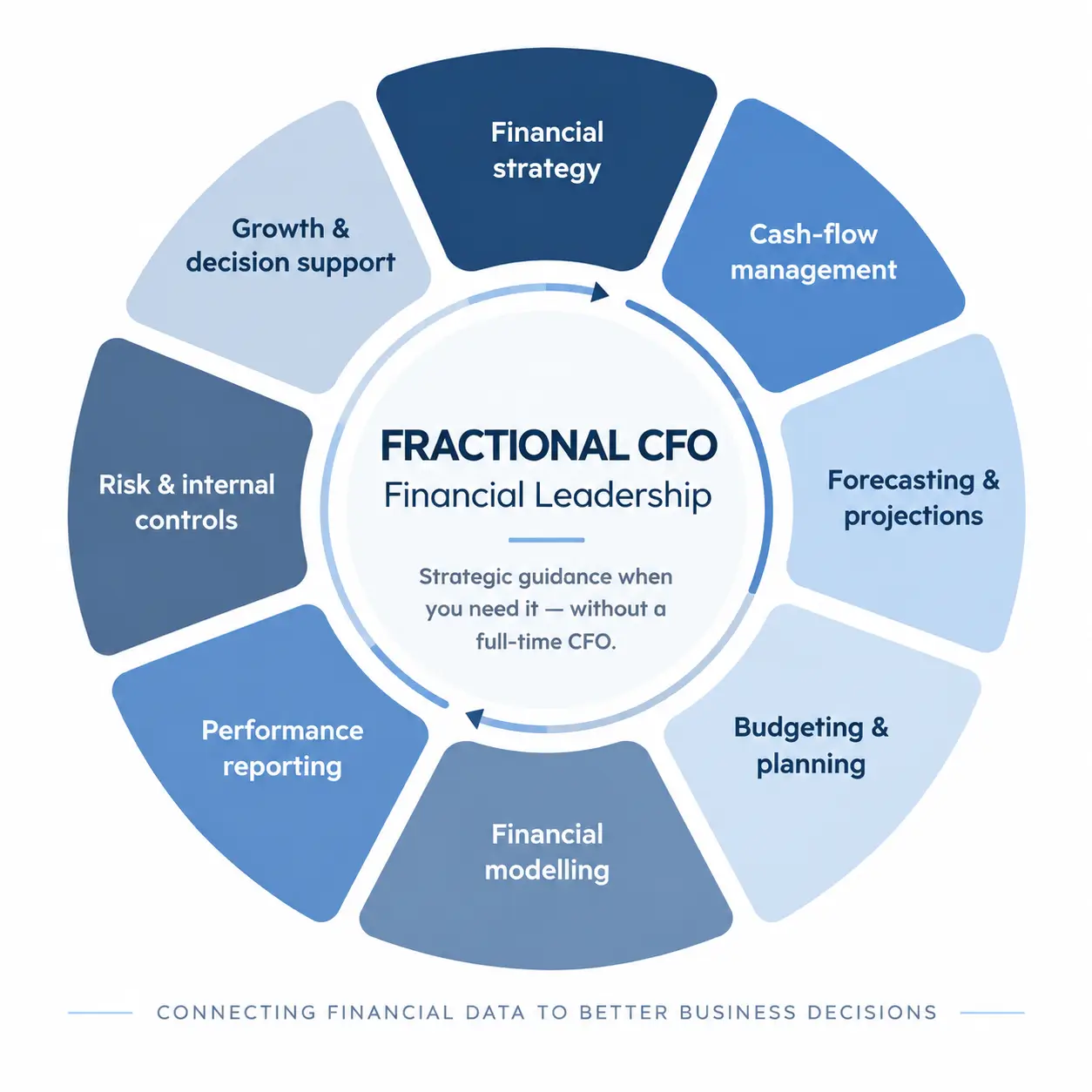
The degree of involvement differs. A few companies might need a fractional CFO for just a few hours every month for the purpose of carrying out financial reviews and providing strategic advice, while others will want more in the way of support, including forecasting, financial modeling, cash flow management, budgeting, financing, management reporting, risk analysis, and taking part in senior management meetings.

The key benefit is that you gain access to expertise at the level of a CFO without having to employ a full-time executive. Different from an outsourced bookkeeper, a fractional CFO concentrates on understanding the company’s financial position, interpreting its financial data, preparing plans, managing risk, and assisting with major decisions.

Related Read:

Comparison Between a Fractional CFO and a Full-Time CFO

The main difference lies in the way the relationship is structured. A full-time CFO is a permanent member of the company’s executive team and usually works for just one organization. A fractional CFO, on the other hand, offers the same kind of strategic financial expertise but works with a business on a part-time or flexible basis. In some cases, this difference means that businesses can gain access to CFO-level expertise. For instance, a company might not require a CFO to work 40 hours a week.

It may, however, need an experienced financial executive several days a month to:

  • Review financial performance
  • Analyze cash flow
  • Build forecasts
  • Prepare management reports
  • Review budgets
  • Develop financial models
  • Evaluate financing options
  • Identify financial risks
  • Participate in management meetings.
  • Help management make major financial decisions.

Instead of hiring a full-time executive when the amount of work does not call for one, the company could get CFO expertise according to its real needs.

Comparison Between a Fractional CFO and a Full-Time CFO

The main difference lies in the way the relationship is structured. A full-time CFO is a permanent member of the company’s executive team and usually works for just one organization. A fractional CFO, on the other hand, offers the same kind of strategic financial expertise but works with a business on a part-time or flexible basis. In some cases, this difference means that businesses can gain access to CFO-level expertise. For instance, a company might not require a CFO to work 40 hours a week.

It may, however, need an experienced financial executive several days a month to:

  • Review financial performance
  • Analyze cash flow
  • Build forecasts
  • Prepare management reports
  • Review budgets
  • Develop financial models
  • Evaluate financing options
  • Identify financial risks
  • Participate in management meetings.
  • Help management make major financial decisions.

Instead of hiring a full-time executive when the amount of work does not call for one, the company could get CFO expertise according to its real needs.

A Fractional CFO As Opposed to an Accountant or a Controller

This distinction matters because these roles often overlap in people’s minds.

Accountant

An accountant generally focuses on recording, classifying, reporting, and analyzing financial transactions and may also provide tax and compliance services depending on their role and qualifications. The accountant helps establish an accurate picture of what has happened financially.

Controller

A controller typically focuses more on the company’s accounting function and financial reporting process.

This can include:

  • Financial statement preparation
  • Accounting policies and procedures
  • Internal controls
  • Accounts receivable and payable oversight
  • Month-end and year-end close
  • Financial reporting
  • Accounting systems
  • Compliance and financial data integrity

The controller makes it possible for the company’s financial information to be accurate, up-to-date, properly controlled, and reliable.

CFO

A CFO generally operates at a more strategic level. The CFO looks at the financial information and asks:

What does this mean for the business?

A CFO may focus on:

  • Financial strategy
  • Forecasting
  • Cash-flow planning
  • Capital requirements
  • Financial modelling
  • Growth strategy
  • Risk management
  • Financing
  • Business performance
  • Investment decisions
  • Acquisitions
  • Exit planning
  • Management decision-making

A simple way to think about the distinction is:

  • The accountant records the figures and prepares the reports.
  • The controller is in charge of the accounting and reporting function.
  • The chief financial officer makes use of financial information in order to assist with running the business.

A business may need one, two, or all three support levels, depending on its size and complexity.

What Is the Real Role of a Fractional CFO?

There is not a single job description that can be applied to every fractional CFO since the role should be adapted to the requirements of the company; nevertheless, fractional CFO services usually cover a number of areas.

Financial Strategy

A fractional CFO can assist management in linking financial decisions to the company’s wider business objectives; for example, if a business wishes to double its revenue over the next three years.

The CFO can help determine:

  • What level of investment may be required?
  • Whether the existing cost structure can support the growth
  • How much working capital may be needed?
  • Whether additional employees should be hired
  • Whether financing may be required
  • What margins the business needs to maintain?
  • Which financial risks could interfere with the strategy?

The goal is to move from a general business goal to a financially structured plan.

Cash-Flow Management

Profit and cash are not one and the same. It is possible for a business to show an accounting profit yet still face cash-flow problems. Customers might pay slowly. A lot of cash may be needed for inventory. Debt payments may come due. And payroll has to be paid no matter when the customers pay their invoices.

A fractional CFO can help management monitor and forecast cash flow so that the company has a better understanding of:

  • Cash coming in
  • Cash going out
  • Upcoming obligations
  • Working capital requirements
  • Seasonal cash requirements
  • Financing needs
  • Potential periods of cash shortage

Cash-flow forecasting enables management to spot problems before they turn into emergencies.

Budgeting

A budget is more valuable when it acts as a management tool than when it is merely a document prepared once a year, and a fractional CFO can assist in drawing up budgets on the basis of operational assumptions before comparing the actual results with those expectations.

This allows management to ask:

  • What is the reason that we are over budget?
  • What is it about that sales are less than what was forecast?
  • Why did payroll increase?
  • Which department is exceeding its expected spending?
  • Is the return from this investment equal to what we had expected?

The aim goes beyond just identifying the variations; it is to find out why they occurred and to determine what action management should take about them.

Forecasting

A budget sets out the company’s expectations in light of its plan, while a forecast poses the question of where we actually stand given what we know today.

A fractional CFO can revise his or her forecasts as new information becomes available, and this in turn helps management to make more informed decisions regarding hiring, spending, capital investment, financing, and growth.

Financial Modeling

Financial modeling lets a company try out different choices and situations before spending resources.

For example:

  • What will occur if sales increase by 15%?
  • What will occur if sales increase by 30%?
  • What would occur if we employed ten more employees?
  • What would occur if we opened another location?
  • What would occur if one of the principal customers disappeared?
  • What will occur if financing costs go up?

A CFO is able to create models which enable management to look at these scenarios and understand the financial consequences.

Management Reporting and KPIs

Many business owners do receive financial statements yet still have no clear understanding of how the company is doing. A fractional CFO can assist in creating management reports based on the metrics that really matter to the business.

Depending on the company, these may include:

  • Revenue growth
  • Gross margin
  • Operating margin
  • EBITDA
  • Cash flow
  • Accounts receivable
  • Customer concentration
  • Inventory turnover
  • Labour costs
  • Customer acquisition costs
  • Recurring revenue
  • Location profitability
  • Product profitability

The key thing is that the KPIs must be relevant to the company’s business model, since there is no single dashboard that suits every organization.


A Fractional CFO Can Bring Direction to a Business

A major advantage of having a fractional CFO is not a specific report or spreadsheet, but rather financial guidance. Although many businesses realize that they want to grow, they are uncertain about which course of action is most financially sound.

An owner might be asking:

  • Should we hire?
  • Should we expand?
  • Should we borrow?
  • Should we invest?
  • Should we go on and get another company?
  • Ought we to open a second location?
  • Should we raise capital?
  • Should we reduce expenses?

Related Read:

Should We Reinvest Profits?

A CFO can assist management in answering these questions from a financial point of view. It does not follow that the CFO is the one who takes the final decision. Rather, the CFO offers analysis, different scenarios, financial context, and insight that enable the owner and the management team to make more informed decisions.

Assisting owners to go from "What's Happening?" to "What's Next?"

The information in financial statements mainly shows you what has already taken place; a CFO’s value usually lies in assisting management with looking to the future. Suppose a business has seen strong revenue growth. That is a positive thing.

But what if:

  • Is gross margin going down?
  • Is the amount paid out in payroll rising more quickly than revenue?
  • Are customers taking more time to pay?
  • Is the demand for inventory rising?
  • Is debt growing?
  • Is the amount of cash reserves decreasing?

Although the business may seem successful on the basis of its revenue it may in fact become more financially vulnerable. A fractional CFO can help to detect these patterns and make them known to management. This ability to look ahead is one of the reasons why CFO support becomes more valuable as the company grows.

Supporting Financing and Raising Capital

The raising of capital is one of those cases where the skills of a CFO can be particularly useful; a business might need financing in order to expand, to buy equipment, to take over another company, to hire staff, to increase its inventory, or to meet its working capital requirements.

  • A fractional CFO can assist with:
  • Determining capital requirements
  • Building financial projections
  • Developing financial models
  • Evaluating debt versus equity
  • Preparing financial information for lenders or investors
  • Analyzing financing scenarios
  • Preparing management for financial questions
  • Supporting due diligence

An experienced chief financial officer can also help in the company’s position when financial issues are being discussed, since investors and lenders might put forward detailed questions on profitability, cash flow, debt, forecasts, margins, assumptions, and the way the funds are to be used.

It is helpful for management to have someone who understands both the business and the financial model, as this enables them to communicate their position more clearly and with greater confidence. 

Preparing for Growth and Expansion

Growth leads to greater financial complexity, and as a company grows it might have:

  • More employees
  • More customers
  • More vendors
  • More locations
  • More inventory
  • Larger contracts
  • More financing
  • More complicated tax considerations
  • Greater working-capital requirements
  • More management reporting requirements

The systems which were adequate when the company was small might no longer be enough, and a fractional CFO could assist management in working out what needs to change as the company grows.

That might include enhancing the way reports are prepared, strengthening the internal controls, introducing new accounting systems, drawing up budgets, preparing forecasts, or redesigning the financial processes.

Risk Management and Internal Controls

The greater businesses grow, the more difficult it becomes to spot financial risk. A fractional CFO can assist management in identifying risks relating to:

  • Cash
  • Debt
  • Customers
  • Suppliers
  • Pricing
  • Margins
  • Fraud
  • Internal controls
  • Financial reporting
  • Business continuity
  • Concentration risk
  • Rapid expansion

The aim is not to get rid of all risk since all businesses involve some risk; rather, it is to understand the risks, assess the extent of their possible impact, and set up suitable controls and responses.

Supporting the Owner During Major Business Decisions

Owners of businesses frequently have to make tough decisions, and having a fractional CFO can provide you with a financial advisor.

For example:

  • Could we afford this acquisition?
  • Whether or not we should purchase or lease the equipment?
  • Could we afford to employ another twenty employees?
  • Since sales are increasing, why is profitability decreasing?
  • How much cash should we set aside?
  • Should we use the money to pay off debt or to reinvest in the business?
  • Could the company provide for another location?

Simple answers are not always available to these questions. A CFO is able to assist in modelling the various alternatives, in identifying the assumptions, and in showing management the possible financial consequences.

The Benefits of a Fractional CFO

The attraction for a great many businesses of having a fractional CFO is that they can obtain experienced financial guidance without being obliged to take on a full-time executive position.

Strategic financial expertise

A fractional CFO can offer experience that extends beyond routine accounting and bookkeeping.

Cost flexibility

Instead of committing to having a full-time executive, the business could pay for the amount of CFO involvement that it really needs.

Better decision-making

Before making any major decisions, management is given a financial analysis and forward-looking insights.

Improved cash-flow visibility

Forecasting enables management to gain a clearer understanding of their future liquidity and financing needs.

Stronger financial planning

A more structured method of managing finances can be achieved through the use of budgets, forecasts, financial models, and KPIs.

Greater accountability

Routine reporting and performance reviews can help managers to stay focused on financial objectives.

Scalability

As the company becomes more complex the level of CFO involvement can go up and it can decrease when the needs change.

Experienced outside perspective

A fractional CFO can provide an independent point of view on financial matters and question the assumptions that might otherwise go unchallenged.

Improved financial confidence

Business owners will feel more confident when facing important negotiations, financing talks, acquisitions, or decisions regarding expansion if they have some financial leadership to back them.

What Are the Disadvantages of Having a Fractional CFO?

A fractional CFO is not the appropriate choice in every case. Since the CFO is not in the office every day, it is important to maintain good communication and to have access to information. The business must also ensure its responsibilities are clearly defined.

For example:

  • Who is the owner of the accounting function?
  • Who is in charge of the bookkeeping team?
  • Who prepares financial statements?
  • Who is responsible for tax matters?
  • Who approves financial decisions?
  • How often will the CFO meet with management?
  • What reports will be generated?
  • What systems will the CFO have access to?

A fractional CFO is also unable to make up for poor-quality financial data; if the basic accounting records are incomplete, inaccurate, or greatly delayed, then it becomes more difficult to make strategic decisions. This is one of the reasons why some companies find it advantageous to combine controller, accounting, and fractional CFO services.

At What Stage Should a Business Consider Hiring a Fractional CFO?

There isn’t a general revenue figure which indicates that a company is ready to have a fractional CFO; instead, the right question to ask is if the business has arrived at a stage of financial complexity at which having extra senior financial leadership would be of value.

A fractional CFO may be worth considering when:

  • The business is growing quickly.
  • Cash flow has become difficult to manage.
  • Management wants better forecasting.
  • Financial decisions are becoming more complex.
  • The company is preparing for financing.
  • The business is expanding into new markets.
  • An acquisition is being considered.
  • The owner is preparing for an exit.
  • Management needs better reporting and KPIs
  • The company lacks senior financial leadership.
  • The owner spends too much time trying to understand financial issues.
  • Financial information exists but is not being used strategically.

Another important sign is when an owner starts saying:

Although I have all the numbers, I still do not know what they mean.

This is usually a sign that the business needs more than just accounting information; it needs financial interpretation and leadership.

Recent Post:

How SDG Accountant Can Help Your Business with Fractional CFO Services?

Growing businesses often reach a stage where basic accounting support is no longer enough. While accurate bookkeeping and tax compliance remain essential, business owners also need strategic financial guidance to understand performance, manage cash flow, plan investments, and make informed decisions.

Our Toronto Accountant team works closely with business owners to transform financial data into practical strategies that support stability, efficiency, and sustainable growth.

  • Strategic Financial Planning and Business Growth Support
  • Cash Flow Management and Forecasting
  • Financial Reporting and Performance Analysis
  • Budgeting and Financial Forecasting
  • Business Advisory and Decision Support
  • Supporting Small and Growing Businesses

Are You Looking for Support from a Fractional CFO Or Controller?

Ready to gain better financial clarity and strategic direction? Contact SDG Accountant today to learn how our Fractional CFO services can support your business growth.

BOOK AN APPOINMENT

The Bottom Line

A fractional CFO is not merely someone who puts together financial reports; the role involves assisting business owners and management in understanding their financial situation, predicting what’s coming up, assessing opportunities, managing risk, and making informed decisions. In a business that is growing, this difference can be between just reacting to financial problems and actively managing the company’s financial future.

A fractional CFO offers the experience and point of view of a senior financial executive at the same time as providing a business with the flexibility of an outsourced arrangement. In the case of companies that already have dependable bookkeeping and accounting but who still need more in the areas of strategy, forecasting, financial modelling, cash-flow management, performance analysis, and financial direction, a fractional CFO can be a useful addition to the management team.

All businesses encounter financial difficulties at different stages. If your requirements are for more accurate financial reporting, improved visibility into cash flow, better budgeting and forecasting, financial modelling, stronger internal controls, or strategic advice from a CFO, the appropriate degree of financial support will enable management to make better decisions with greater confidence.

Ask our SDG Accountant team about your business, your present financial requirements, and the direction you would like your company to go in.

Frequently Asked Questions

A Fractional CFO is an experienced financial executive who provides CFO-level guidance to a business on a part-time, contract, or outsourced basis.

The cost of a Fractional CFO depends on the scope of services, business complexity, required expertise, and engagement structure.

Fractional CFO services may include financial forecasting, cash-flow management, budgeting, KPI reporting, profitability analysis, strategic planning, and business advisory.

Businesses often consider a Fractional CFO when they need advanced financial guidance but do not require a full-time CFO.

An accountant typically focuses on financial records, compliance, and reporting, while a Fractional CFO focuses on strategy, forecasting, decision-making, and business growth.

Disclaimer

The information in this blog post is provided for general informational purposes only and should not be considered professional accounting, tax, financial, or business advice. Every business has unique circumstances, and strategies may vary based on individual needs.

SDG Accountant recommends consulting with a qualified professional before making financial or business decisions. The information provided does not guarantee specific results, savings, or business outcomes. For personalized guidance, please contact SDG Accountant directly.

The information is not intended to constitute professional advice and may not be appropriate for a specific individual or fact situation. It is written by the author solely in their personal capacity and cannot be attributed to the accounting firm with which they are affiliated. It is not intended to constitute professional advice, and neither the author nor the firm with which the author is associated shall accept any liability in respect of any reliance on the information contained herein. Readers should always consult with their professional advisors in respect of their particular situations.

Sami Ghaith
CPA, CGA, MBA

Share Now

Contact

Get In Touch

News Feeds

Blogs & Insights